
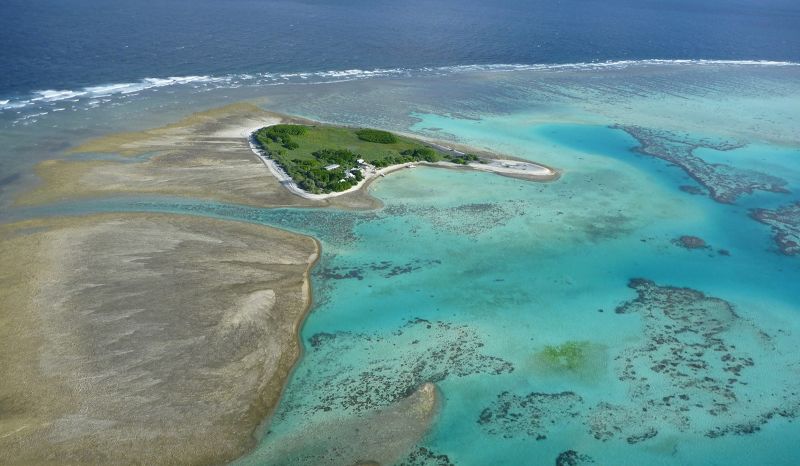
Record ocean heat has taken a devastating toll on one of the world’s greatest natural wonders, with coral bleaching on Australia’s Great Barrier Reef reaching “catastrophic” levels, a new study has found.
More than 50% of affected corals monitored near an island in the reef’s south were killed last year during the most “severe and widespread bleaching” to ever hit the area, according to a team of Australian scientists.
In 2024, the reef experienced its worst summer on record. Soaring ocean temperatures smashed records, causing the reef’s seventh mass bleaching event. Corals are bleached white when marine heat waves put corals under stress, causing them to expel algae from their tissue, draining their color.
The culprit is the burning of planet-heating fossil fuels, which is driving up global temperatures. Coral damage was also accelerated last year by the El Niño weather pattern, which heats ocean temperatures in this part of the world.
Scientists from the University of Sydney tracked 462 coral colonies at the reef’s One Tree Island over the course of five months last year, beginning at the heat wave’s peak in early February.
By May, 370 of those colonies were bleached and, by July, 52% of the bleached corals were dead, according to the peer-reviewed study published in Limnology and Oceanography Letters.
Some coral species monitored had a mortality rate of 95%, with researchers observing the start of “colony collapse” where the dead skeleton detaches from the reef and turns to rubble.
Another species, the Goniopora, became infected by black band disease, which invades the coral’s tissue and can kill it.
“Our findings underscore the urgent need for action to protect coral reefs, which are not only biodiversity hotspots but also crucial for food security and coastal protection,” said lead author Maria Byrne, from the School of Life and Environmental Sciences at the university.
Byrne said the area studied is in a protected part of the reef, far from the coast and free from mining activities and tourism.
But the reef, “despite its protected status, was not immune to the extreme heat stress that triggered this catastrophic bleaching event,” she said.
Covering nearly 133,000 square miles (345,000 square kilometers), the Great Barrier Reef is the world’s largest coral reef, home to more than 1,500 species of fish and 411 species of hard corals. It contributes billions of dollars to the Australian economy each year, mainly through tourism, and is promoted heavily to foreign visitors as one of the country’s – and the world’s – greatest natural wonders.
The authors said mass bleaching is becoming “a biennial event” and as such “reinforces the need for urgent global action now to adhere to ambitious climate and reduced emissions targets.”
The bleaching hit areas of the reef not impacted before, and disease and death were found in coral species considered resilient, the study found.
“Seeing the impacts on a reef that has largely avoided mass bleaching until now is devastating,” said Shawna Foo, a marine scientist and co-author of the study. “The high rates of mortality and disease, particularly in such a remote and pristine area, highlight the severity of the situation.”
Severe mass bleaching at the Great Barrier Reef had previously been observed in 1998, 2002, 2016, 2017, 2020 and 2022.
The 2022 bleaching was the first during a La Niña event, El Niño’s counterpart, which tends to have a cooling influence – raising serious concerns about the reef’s outlook.
The authors said their research was a “wake-up call for policymakers and conservationists” as its implications extend beyond ecology and conservation to communities that depend on the reef for fishing, tourism and coastal protection.
“The resilience of coral reefs is being tested like never before, and we must prioritize strategies that enhance their ability to withstand climate change,” said Ana Vila Concejo, co-author of the study from the university’s School of Geosciences.
“Our findings underscore the need for immediate and effective management interventions to safeguard these ecosystems.”