
In every crisis lies opportunity, and in every opportunity lurks crisis.
The startling advance of Syria’s opposition in a week is the unintended consequence of two other conflicts, one near and one far. It leaves several key US allies with a new and largely unknown Islamist-led force, governing swathes of their strategic neighbor – if not most of it, given the pace of events, by the time you read this.
Syria has absorbed so much diplomatic oxygen in the past 20 years, it is fitting this week of sweeping change popped up as if from a vacuum. Since the invasion of Iraq, the US has struggled to find a policy for Syria that could accommodate the vastly different needs of its allies Israel, Jordan, Turkey, and its sometime partners Iraq and Lebanon.
Syria has always been the wing-nut of the region: linking Iraq’s oil to the Mediterranean, the Shia of Iraq and Iran to Lebanon, and NATO’s southern underbelly Turkey to Jordan’s deserts. George W Bush put it in his Axis of Evil; Obama didn’t want to touch it much in case he broke it further; Donald Trump bombed it once, very quickly.
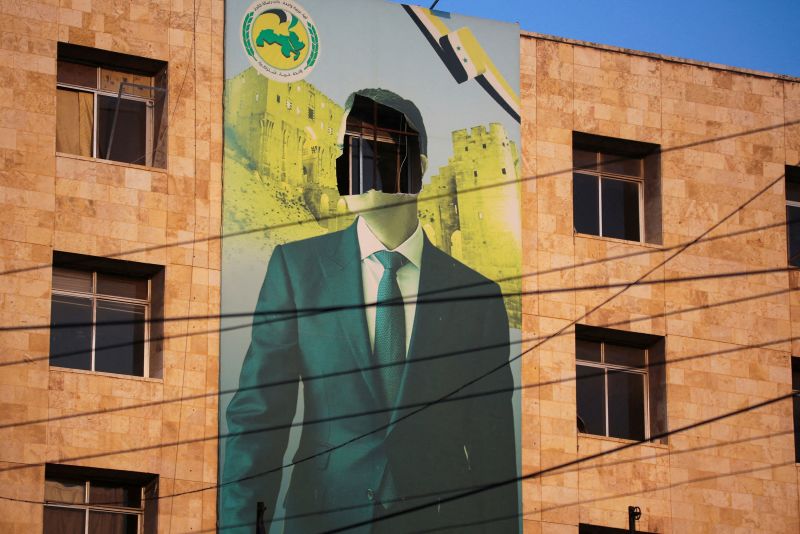
It has been in the grip of a horrifically brutal dictatorship for decades. Hama, Homs, Damascus – all again in the headlines overnight because of the regime’s swift fall, yet too home to the most heinous parts of its history – respectively the 1982 massacre of 20,000 in Hama, or the 2012 siege and then starvation of Homs, or the gassing with Sarin in Ghouta, near Damascus, of children in basements in 2013. Then there was ISIS from 2014 to 2017. There seemed little more you could subject Syria to, until this week brought it liberation, thus far at an unknown cost, with vast caveats.
The swiftly changing fate of Bashar al-Assad was not really made in Syria, but in southern Beirut and Donetsk. Without the physical crutches of Russia’s air force and Iran’s proxy muscle Hezbollah, he toppled when finally pushed.
Israel’s brutal yet effective two-month war on Hezbollah probably did not pay much mind to Assad’s fate. But it may have decided it. Likewise, the Russian invasion of Ukraine, 34 months ago, likely considered little how few jets or troops it might leave Moscow to uphold its Middle Eastern allies with. But the war of attrition has left Russia “incapable” of assisting Assad, even President-elect Donald Trump noted on Saturday. And indeed Russia’s Foreign Minister Sergei Lavrov cut a weakened figure this weekend, saying: “What is the forecast? I cannot guess. We are not in the business of guessing.” These are not the words of a steadfast and capable guarantor, rather those of a regional power seeing its spinning plates hit the floor.
Iran has been wildly hamstrung in the past six months, as its war with Israel, usually in the shadows or deniable, evolved into high-stakes and largely ineffective long-range missile attacks. Its main proxy, Hezbollah, was crippled by a pager attack on its hierarchy, and then by weeks of vicious airstrikes. Tehran’s pledges of support have done little so far but result in a joint statement with Syria and Iraq on “a need for collective action to confront” the rebels.
The Middle East is reeling because ideas taken as a given – like pervasive Iranian strength, and Russian solidity as an ally – are crumbling as they meet new realities. Assad prevailed as the leader of a blood-drenched minority, not through guile or grit, but because Iran murdered for him and Moscow bombed for him. Now these two allies are wildly over-stretched elsewhere, the imbalance that kept Assad and his ruling Alawite minority at the helm is also gone.
When established regional powers seem suddenly unable to act, there is often a moment of significant risk. But this is one seized by Turkey, a NATO member which has dealt with the most fallout from Syria’s turmoil.
Ankara has had to play the long game over Syria, and housed over three million of its refugees since 2012. It has had to see the Kurdish militants – the Syrian Democratic Forces (SDF) that the US trained, equipped and helped to fight ISIS – develop a stronghold along its border. From Ankara’s perspective, the Syria problem has never gone away even though attention to it faded; it would one day need to alter the enduring mess in its favor.
The sweeping offensive by Hayat Tahrir al-Shams (HTS) – with its impetus, equipment and inclusive communications strategy, telling Syria’s disparate and panicked ethnic groups their new society would view them all as one – spoke of a sophisticated hand behind it. Turkish President Recep Tayyip Erdoğan made his strongest suggestion to date whose hand that was when he said Friday he had tried to negotiate the future of Syria with Assad, failed, and he wished the offensive well, all the way to the Syrian capital. It was not a subtle message. But it does not need to be at a time of seismic change Erdogan has likely long awaited.
Exactly who Turkey has empowered remains unclear. HTS’s upper echelons, in short, began as al-Qaeda, found ISIS too extreme, and are now trying to suggest they’ve grown up. From Ireland to Afghanistan, the history of this sort of evolution is messy. It’s not always simple for extremists to reform, yet also possible sometimes they can change just about enough. Separately, while Turkey may have lit the touch paper of HTS assaults, the speed of Assad’s collapse may not have been anticipated. There is such a thing as too great a success.
The unknowable impact of vast, fast change left Syria mired in half-policies and US inaction before. Back in 2013, then-US President Barack Obama said he would retaliate militarily if Assad used chemical weapons, but did not enforce this “red line” when Assad deployed Sarin in Ghouta in 2013. His officials partially justified his walkback by suggesting too much further damage to the already frail Assad regime could let increasingly jihadist rebels to advance so fast, they could be in control of Damascus in months. It is possible they were right back then; it is yet more likely the failure by Obama to act emboldened Russia and Iran for years.
We don’t know a lot about what is happening now in Syria or what it means. HTS may prove a better governor of Syria’s ethnic mix than Assad was, which won’t be hard. Assad may melt away into exile in a lavish row of Moscow dachas, and his hollow autocracy may crumble fast. Russia may lick its geopolitical wounds and concentrate on the catastrophic bleed that is its invasion of Ukraine. Iran may pause to reflect, and instead ready itself for the possible tsunami of aggression that could come with Trump’s White House.
Obama’s argument was made to a Western audience exhausted by Iraq and Afghanistan, and preoccupied by terrorism. And it marked a form of war-weary isolationism, in which an over-stretched US was reluctant to instigate more change it could not control. Obama ended up funding and arming the Syrian opposition so feebly it was slaughtered and – when its extremists joined up with radicals from Iraq’s long-running insurgency against the US occupation – metastasized into ISIS. That was about the worst possible outcome. The West had played its hand so weakly in one low-grade conflict, it won the four-year industrial-strength horror of a war against the ISIS caliphate.
This may prove the swift and severe change that Syria needed to stabilize – a shaking of the carpet that leaves society smoother. Syria’s past 13 years have been so brutal it deserves exactly that. Yet they have also proven how out of reach peace can be, and deep its suffering can go.