
‘The U.S. struggle with China is the single greatest competition the United States has ever faced,’ defense analyst Seth Jones writes in his new book The American Edge.
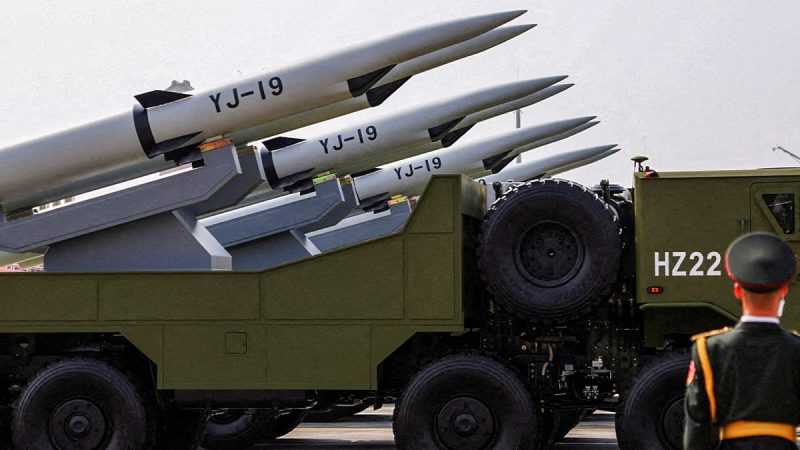
And in an interview with Fox News Digital, Jones warned that if war broke out over Taiwan, the United States could burn through key long-range missiles ‘after roughly a week or so of conflict’ — a shortfall he says exposes how far behind the U.S. industrial base remains as Beijing moves onto what he calls a wartime footing.
Jones is a former Pentagon official and president of the Defense and Security Department at the Center for Strategic and International Studies (CSIS). He argues the United States isn’t dealing with a superpower like the Soviet Union, whose system was brittle and economically isolated. China’s economy, he noted, is roughly the size of the U.S. and deeply tied into global production. That economic weight is fueling a military buildup across every major domain, from fifth- and sixth-generation aircraft to an enormous shipbuilding sector he describes as ‘upwards of 230 times the size of the United States.’ The effect, he said, is unmistakable. ‘The gap is shrinking.’
In ‘The American Edge,’ Jones lays out how great powers historically win long wars through production, not just innovation — and that’s where he believes the U.S. has the most to worry about. China’s missile forces now field a wide range of weapons designed to hold U.S. ships and aircraft at risk far from Taiwan. That makes stockpiles and throughput central to any American strategy in the Indo-Pacific.
‘When you look at the numbers right now of those long-range munitions, we still right now would run out after roughly a week or so of conflict over Taiwan,’ he said. ‘That’s just not enough to sustain a protracted war.’
Jones stressed that China’s strengths often overshadow a major vulnerability: its limited ability to hunt submarines. He said Beijing ‘still can’t see that well undersea,’ a gap the U.S. could exploit in any fight over Taiwan. If China tried to ferry troops across the Strait or impose a blockade, American attack submarines — along with a larger fleet of unmanned underwater vehicles — would pose a serious threat. He called the undersea environment one of the few places where the U.S. retains a decisive advantage, and one where production should accelerate quickly.
China has other problems as well. Jones pointed to corruption inside the PLA, inefficiency across its state-owned defense firms, ongoing struggles with joint operations and command-and-control and the fact the Chinese military hasn’t fought a war since the late 1970s. Its ability to project power beyond the first island chain also remains limited. But none of those challenges, he said, change the broader trajectory: China is building weapons in mass and at high speed — and the U.S. is still trying to catch up.
That theme sits at the center of his book. Jones describes a U.S. defense industrial base constrained by long acquisition timelines, aging shipyards, complicated contracting rules and production lines that aren’t built for a modern great-power conflict. In his view, the United States must rediscover the industrial urgency that once allowed it to surge output in wartime.
That responsibility is now falling to the Trump administration, which has pushed the Pentagon and the services to move faster on drones, munitions and new maritime capabilities. Over the past year, the Army, Air Force and Navy have launched new rapid-acquisition offices and programs aimed at fielding systems more quickly and helping smaller companies survive the long, expensive path to production. Senior defense officials have started using the phrase ‘wartime footing’ to describe the moment — language Jones said is overdue.
‘That is exactly the right wording,’ he said. ‘The Chinese and the Russian industrial bases right now … are both on a wartime footing.’
He said identifying a set of priority munitions for multiyear procurement is a meaningful step, and early moves to streamline contracting are encouraging. But he cautioned that the scale of the problem is much larger than the reforms announced so far. ‘The Pentagon writ large is a massive bureaucracy,’ he said. ‘It’s going to take a lot to break that bureaucracy. There’s been some progress, but it’s trench warfare right now.’
Jones said parts of the new National Defense Authorization Act move the needle in the right direction — especially support for expanding shipbuilding and efforts to strengthen the defense workforce. He also pointed to growing interest in leveraging allied shipyards in Japan and South Korea to relieve America’s overburdened maritime industry. But he argued that Washington is still not investing at a level that matches the threat.
‘As a percentage of gross domestic product, [defense spending] is about three percent,’ he said. ‘It’s lower than at any time during the Cold War. I think we need to start getting closer to those numbers and increase the amount of that budget that goes into procurement and acquisition.’
Artificial intelligence is another area Jones believes will reshape the battlefield faster than Washington anticipates. He noted that missile and drone threats now move at a volume and speed no human operator can manually track. ‘You can’t do things like air defense now without an increasing role of artificial intelligence,’ he said. The same applies to intelligence and surveillance, where AI-driven systems are already sorting vast amounts of satellite and sensor data.
But Jones said the United States will fall behind unless the Pentagon brings commercial AI leaders — companies like Nvidia and Google — more directly into national security programs. He argued that the United States needs the opposite of the consolidation that collapsed the defense industry in the 1990s. ‘We’ve got to get to a first breakfast,’ he said, meaning more tech firms competing in the defense space, not fewer.
Despite his warnings, Jones said the United States still has time to rebuild its industrial advantage. But it must act quickly. The Trump administration is talking about a wartime footing. China, he warned, is already living it.