
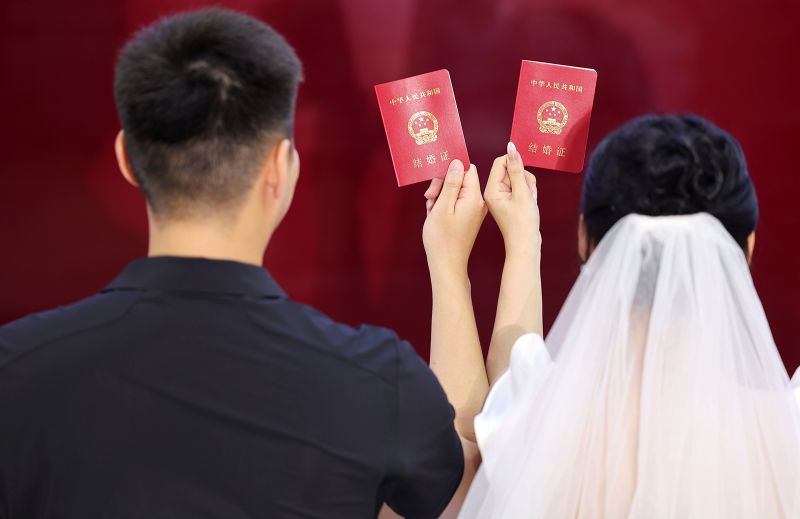
The number of new marriages recorded in China is on course to fall to the lowest level in decades this year, official data shows, as the country’s demographic crisis deepens despite a sweeping government campaign to boost matrimony and encourage births.
Plummeting marriages – and births – pose a major challenge to Beijing, which is increasingly worried about the impact of a shrinking workforce and aging population on the country’s slowing economy.
Some 4.74 million Chinese couples registered their marriages in the first three quarters of 2024, a decrease of 16.6% from the 5.69 million recorded in the same period last year, according to data released by the Ministry of Civil Affairs on Friday.
The decline is consistent with a falling trend from a 2013 peak of more than 13 million new marriages, and in line with predictions by Chinese demographic experts that the number of marriages in 2024 will drop to the lowest level since the 7.2 million recorded in 1980.
A rebound in marriages last year after stringent Covid restrictions were lifted appears to be an anomaly largely driven by pent-up demand.
China’s population has shrunk for two years in a row and its birth rate last year was the lowest since the founding of the People’s Republic in 1949. In 2022, the country was surpassed by India as the world’s most populous nation.
Chinese officials see a direct link between fewer marriages and falling births in the country, where social norms and government regulations make it challenging for unmarried couples to have children.
To reverse the decline, Chinese officials have rolled out a raft of measures, from financial incentives to propaganda campaigns, to nudge young people to tie the knot and have children.
Officials have organized blind dating events, mass weddings, and attempted to curtail the tradition of large “bride price” payments from the groom to his future wife’s family that put marriage out of reach for many poor men in rural areas.
Since 2022, China’s Family Planning Association has launched pilot programs to create a “new-era marriage and childbearing culture,” enrolling dozens of cities to promote the “social value of childbearing” and encouraging young people to get married and give birth at an “appropriate age.”
But so far, these policies have failed to convince Chinese young adults who are grappling with high unemployment, the rising cost of living and a lack of more robust social welfare support amid the economic slowdown.
Many are postponing marriage and childbirth – and a growing number of young people even choose to eschew them entirely.
The decline in both marriages and births is partly due to decades of policies designed to limit China’s population growth, which resulted in fewer young people of marriageable age, according to Chinese officials and sociologists.
In 2015, China announced an end to its decades-long one-child policy, allowing couples to have two children, then increased that to three children in 2021 – but both marriage and birth rates continued to drop.
The stubborn downward trend is also a result of changing attitudes to marriage, especially among young women who are becoming more educated and financially independent.
Faced with widespread workplace discrimination and patriarchal traditions – such as the expectation for women to be responsible for childcare and housework – some women are growing disillusioned with marriage.
Since 2021, China has mandated a 30-day “cooling-off” period for people filing for divorce, despite criticism that it could make it harder for women to leave broken or even abusive marriages. In the first nine months of this year, some 1.96 million couples registered for divorces, a slight decline of 6,000 year-on-year, according to data from the Ministry of Civil Affairs.
China isn’t the only country struggling with falling rates of marriage and birth. In recent years, Japan and South Korea have also introduced measures to encourage births – such as financial incentives, cash vouchers, housing subsidies and more childcare support – with limited success.